How to Prepare for Pregnancy: What Actually Matters in the 3–6 Months Before You Start Trying
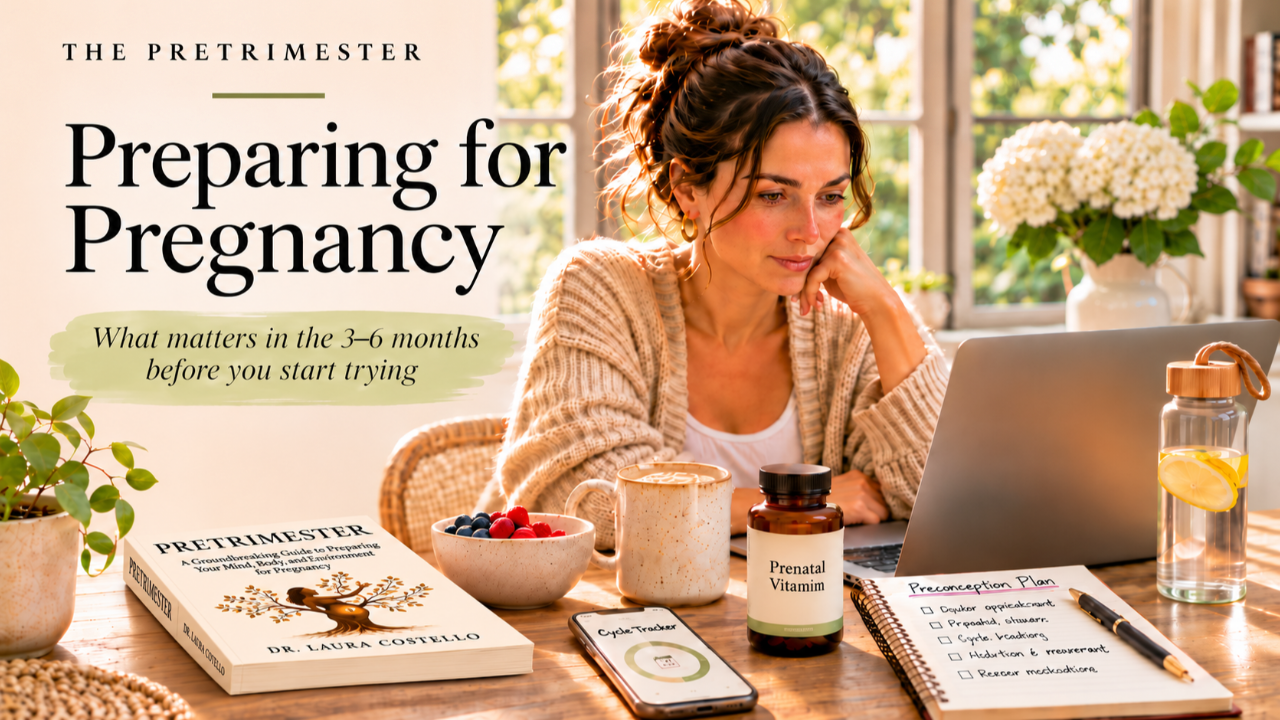
There's a particular kind of research spiral that starts when you decide it's almost time to have a baby.
One minute you're calculating a possible due date. The next you're standing in the vitamin aisle comparing prenatals, wondering if you should give up coffee, and reading that half the products in your bathroom might be interfering with your hormones.
How did we get here?
When Andy and I decided to start a family, I'd stayed on birth control until we were absolutely, positively ready. I genuinely thought the minute I stopped, I'd get pregnant.
Boy, was I wrong.
I'd been so focused on making sure we were ready to start trying that I never really thought about what I should be doing beforehand. Looking back, there was so much about my own fertility I didn't understand. I didn't even know what questions to ask.
That's a big part of why I care so much about this conversation. There are meaningful things you can do before pregnancy, but I also want to save you from spending a small fortune on supplements, replacing everything in your kitchen, or treating preparation like another full-time job.
As much as I love a good plan, doing more isn't always doing better. Here's where I'd actually put your time and attention.
Why Start Preparing 3–6 Months Before Pregnancy?
We've all heard about the three trimesters of pregnancy. But what about the months leading up to them?
That's what I call the pretrimester: the intentional period before conception dedicated to preparing your mind, body, and environment for pregnancy.
Think about how much planning goes into other big life decisions. We research homes, compare insurance plans, and spend weeks debating which car to buy. Yet many women receive surprisingly little guidance about pregnancy until they're already expecting or having trouble conceiving.
Pregnancy is already underway by the time you see a positive test. Some of the earliest stages of your baby's development happen before you even know you're pregnant, which is why getting enough folic acid beforehand matters. Other preparations take time for different reasons. Maybe you need to adjust a medication, get an existing health condition under better control, or look into irregular periods. These are things worth knowing about sooner, while you have time to ask questions, explore your options, and make a plan.
I like the three-to-six-month window because it gives you breathing room to make appointments, ask questions, and establish useful habits. But it's a planning tool, not a required waiting period. If you're ready to start trying sooner, you haven't missed your chance to prepare.
1. Make the Appointment You Might Not Realize You Need
If you take one thing from this article, let it be this: you don't have to wait until there's a problem to talk to your doctor about getting pregnant.
Schedule a preconception appointment, even if you're still taking birth control and pregnancy is several months away.
Use the visit to review your health history, prescription and over-the-counter medications, supplements, vaccinations, and any symptoms you've been wondering about. Conditions such as thyroid disease, diabetes, or high blood pressure may require a plan before conception. Your provider can also discuss genetic carrier screening and whether other testing is appropriate.
And please don't stop a prescribed medication on your own because you're planning a pregnancy. Some medications need to be continued; others should be adjusted with your prescriber.
Do you need fertility testing before you start trying?
Here's where I might save you some money and a lot of unnecessary worrying.
You've probably seen lists of tests every woman supposedly needs: AMH, FSH, estrogen, progesterone, and a thyroid panel. Enough to make you think you should arrive at your appointment with a spreadsheet.
But a preconception visit and an infertility evaluation are different things. Take AMH, or anti-Müllerian hormone. It's often marketed as a fertility test, yet its main clinical value is helping predict ovarian response during fertility treatment. In a woman without known infertility, it cannot reliably predict whether she'll conceive naturally.
I'm not against testing. I'm all for investigating symptoms and advocating for answers. I just want each test to have a reason behind it.
Ask your provider, "Based on my history and our plans, is there anything we should investigate now, and how would the result change what we do?"
That's a far better starting point than ordering everything you've heard about online.
2. Start a Prenatal Vitamin, and Be Selective About Everything Else
Choosing a prenatal vitamin shouldn't require a graduate-level course in supplement labels, yet here we are. Gummies, capsules, powders, methylated this, activated that. And don't forget all those products promising better egg quality.
Let's start with what we know.
If you may become pregnant, aim to get at least 400 micrograms of folic acid every day, beginning at least one month before conception. Folic acid helps prevent neural tube defects, serious birth defects involving the developing brain and spine. Those structures form very early, sometimes before you've missed a period.
A prenatal containing folic acid is a practical option. Check the label, and review your needs with your healthcare provider, particularly if you follow a restricted diet, have a medical condition, or take medications that affect nutrient requirements. Some women need a higher prescribed dose of folic acid. Taking multiple prenatal vitamins to get more isn't a safe workaround.
What about CoQ10, DHEA, and the other fertility supplements filling your feed? Some have been studied in specific treatment settings, but that doesn't make them necessary, effective, or safe for everyone preparing to conceive. Evidence for many products remains limited, and some can carry risks.
I understand wanting every possible advantage. I really do. But there's a difference between a supplement that sounds promising and one that's shown to improve an outcome that matters.
Start with the proven fundamentals. Consider anything else for a specific reason, with appropriate medical guidance.
3. Get to Know Your Menstrual Cycle
For years, many of us spend an awful lot of energy trying not to get pregnant. Then one day we're ready, and suddenly we're supposed to understand ovulation, fertile windows, cervical mucus, and hormone fluctuations.
Quite a learning curve.
You don't need to buy ovulation tests by the case. Begin with what's normal for you: how often your period arrives, whether the timing is fairly consistent, and whether you're experiencing heavy bleeding, spotting, or significant pelvic pain.
Regular, predictable cycles often suggest ovulation is occurring, although they can't tell us everything about fertility. Irregular or absent periods, bleeding between periods, and substantial pain deserve a conversation with your healthcare provider. Conditions such as endometriosis, polyendocrine metabolic ovarian syndrome (PMOS), formerly known as polycystic ovary syndrome (PCOS), and thyroid disorders can affect reproductive health.
One thing I feel strongly about: don't dismiss a symptom just because you've lived with it for years. Severe period pain shouldn't automatically be accepted as normal.
Still on birth control?
Ask your provider what to expect when you stop. Fertility can return quickly after many methods, including the pill, and there's generally no medical need to wait several months for your body to "detox" before trying. Your natural cycle may need a little time to become predictable, particularly if it was irregular before contraception.
The contraceptive injection is different; the return of ovulation can take longer after the last shot. That's worth knowing if you have a specific timeline in mind.
The goal is to understand your body, not turn your cycle into another daily performance review.
4. Take a Closer Look at What's on Your Plate
Eat more protein. Cut out dairy. Go gluten-free. Avoid sugar. Buy everything organic.
No wonder women start questioning every bite.
Nutrition matters. Your body needs adequate energy and a variety of nutrients to support your health and a future pregnancy. But there's no single magic fertility diet.
I'd begin with your actual routine. Are you skipping lunch because work gets busy? Eating vegetables but very little protein? Relying on whatever's easiest at the end of an exhausting day? Those patterns may be more useful to address than the latest ingredient someone has declared off-limits.
For most women, a sensible foundation includes plenty of vegetables and fruit, adequate protein, fiber-rich carbohydrates, and healthy fats. Specific dietary restrictions, nutrient deficiencies, or conditions affecting absorption may warrant individualized guidance.
Researchers have studied dietary patterns, including Mediterranean-style eating, and reproductive outcomes. Some findings are encouraging, but the evidence doesn't establish one diet that will reliably improve natural fertility for every woman.
Unless you have a medical reason, I wouldn't start eliminating entire food groups or doing an aggressive cleanse because you're hoping to conceive.
I'd rather see you make a few changes you can maintain than follow a perfect meal plan for two weeks and abandon it because you're miserable.
5. Build Strength for Pregnancy and Beyond
We spend so much time talking about what women should eat and which supplements they should take before pregnancy, but physical preparation often gets overlooked.
Think about what your body will be asked to do over the next year or two. Pregnancy changes your center of gravity, places new demands on your muscles and cardiovascular system, and affects how you move. Then comes recovery and the surprisingly physical work of caring for a baby.
I've spent much of my career helping people build strength, move better, and regain function. I wish physical preparation were part of more preconception conversations, because building strength and endurance now can support how you feel and function through these changes, and well beyond pregnancy.
For most healthy adults, the general recommendation is at least 150 minutes of moderate aerobic activity a week, plus muscle-strengthening activity on two or more days. That might look like brisk walks and a couple of strength-training sessions, not an elaborate workout program.
If you're active already, great. If you're starting from scratch, begin where you are. You don't need to reach a certain weight or be in the best shape of your life before getting pregnant.
And please pay attention to pelvic health. Pain with intercourse, persistent pelvic pain, and urinary symptoms are reasons to consider a qualified pelvic floor physical therapist. Addressing those issues can improve comfort and function, even though pelvic floor treatment isn't a proven way to increase fertility.
6. Be Smart About Exposures Without Replacing Everything You Own
I have a feeling this section could save someone a very expensive shopping trip.
Read enough fertility advice and you'll start questioning your water bottle, cookware, makeup, cleaning supplies, and half the things in your house. Because you want to do what's best, it can feel easier to replace everything than to sort through the evidence.
But not every exposure carries the same level of risk.
Some priorities are clear. Avoid smoking, nicotine, recreational drugs, and alcohol while trying to conceive. If you drink coffee, keeping caffeine below about 200 milligrams a day is a sensible precaution as you prepare for pregnancy.
If your job involves pesticides, solvents, heavy metals, radiation, or another potential reproductive hazard, discuss it with your healthcare provider or occupational health team. At home, using products as directed, ventilating spaces while cleaning, and addressing known hazards are reasonable steps.
Research into many everyday environmental chemicals is still developing. We should take those questions seriously without presenting every headline as proof of harm.
I wouldn't tell you to throw out every plastic container or spend thousands recreating your kitchen. Prioritize established risks first. Be skeptical of anyone selling you an entirely new lifestyle as the price of protecting your fertility.
7. Don't Forget About the Other Half of the Equation
One thing that has always bothered me about fertility conversations is how quickly the responsibility lands on women.
We're told to track our cycles, adjust our diets, schedule appointments, take supplements, and manage stress. Meanwhile, sperm health gets a passing mention, if any.
If you're preparing with a partner who contributes sperm, their health matters too. Smoking, certain medical conditions and medications, and testosterone use can affect sperm production or function. Preparation shouldn't fall entirely on your shoulders.
There are practical conversations worth having together as well: What timeline are you picturing? What support will you need? How will you handle appointments or unexpected decisions if things don't unfold as planned?
Andy and I learned through our fertility experience how important it is to face those decisions together.
And how are you doing?
There's another part of preparation that doesn't fit neatly on a checklist.
Maybe you're excited to start trying. Maybe your career, finances, age, or family expectations are making the decision feel more complicated. Either way, your sleep and emotional health deserve attention.
If you're dealing with persistent anxiety, depression, or sleep problems, bring them into your preconception conversations. Getting support is worthwhile in its own right.
And if someone tells you to "just relax" to get pregnant, I'd take that advice with a very large grain of salt. Managing stress can support your well-being, but ordinary stress and difficult emotions aren't proof that you've caused a fertility problem.
8. Here's What Can Wait
We've become very good at giving women more things to worry about. I'd like to take a few off your list.
If you have no symptoms or known fertility concerns, you may not need an extensive hormone panel, six different fertility supplements, an elaborate ovulation-tracking setup, or a complete replacement of your household products.
There will always be another promising study, another trend, and someone online who swears a particular routine changed everything. That doesn't mean you need to try it.
Of course, your priorities may be different if you have irregular cycles, significant pain, an existing diagnosis, or a personal or family history that raises concerns. That's why context matters.
Don't measure your preparation by the number of things you've purchased or changed. Measure it by whether you understand your health better and know what makes sense for you.
9. Know When Not to Wait
You've probably heard you should try for a year before seeing a fertility specialist. That's not the whole story.
Under current American Society for Reproductive Medicine guidance, evaluation is generally recommended after 12 months of unsuccessful attempts when the female partner is under 35, or after six months at age 35 and older. For women over 40, more immediate evaluation may be appropriate.
But those timelines are for people without a known reason to suspect a fertility issue. Irregular or absent periods, known or suspected endometriosis, recurrent pregnancy loss, certain pelvic conditions, or a known sperm-related concern may warrant earlier evaluation. When applicable, both partners should be assessed.
I learned through some difficult experiences how important it is to advocate for yourself and find a care team that takes your concerns seriously. You don't have to wait for an arbitrary number of disappointing months to ask a question your history already gives you reason to ask.
Where I'd Start This Week
If you're hoping to begin trying in the next three to six months, here's my short list:
-
Book a preconception visit. Bring your medication list, medical history, and questions, including any symptoms you've been putting off discussing.
-
Start with folic acid. Choose an appropriate prenatal or supplement providing at least 400 micrograms daily, unless your clinician recommends another dose.
-
Pay attention to your cycle and everyday habits. Build realistic nutrition and movement routines, and address established health risks rather than chasing every online recommendation.
Then let what you learn guide the next step. If you're ready to try sooner, these are still worthwhile places to begin.
A More Thoughtful Way to Prepare
Looking back, I think about how much time I spent researching, planning, and trying to figure everything out. I was used to working hard and finding solutions. Fertility was one of the first times I had to accept that I couldn't control the outcome simply by doing more.
That's part of why I created The Pretrimester. I want women to have the information I wish I'd had earlier: what questions to ask, what deserves investigation, and which changes are actually worth their energy.
You can't predict every part of this journey. But you can make thoughtful decisions with the information you have now, without putting the rest of your life on hold.
A Place to Begin
If you'd like some structure, my free 7-Day Preconception Reset offers a week of simple, guided activities around nourishment, movement, sleep, and everyday habits.
In your corner,
Dr. Laura
Explore the free 7-Day Preconception Reset.
Medical References
SUBSCRIBE FOR WEEKLY LIFE LESSONS
Lorem ipsum dolor sit amet, metus at rhoncus dapibus, habitasse vitae cubilia odio sed.
We hate SPAM. We will never sell your information, for any reason.
Meet the Author